Jewellery investment: Advice on how to navigate the current volatile market
Marilyn Monroe sang that diamonds are a daughter's best friend. But if anyone is considering them for investment purposes, the state of affairs is rather more complicated.
In the past two years, a string of blockbuster auctions has pushed the price of the most valuable jewels to new highs. But the volatile, and oftentimes opaque, nature of the jewellery market means that while gems tin exist a good store of value, they are not always a proficient investment.
"Exceptional diamonds, gemstones, jewels with extraordinary provenance and signed pieces have e'er been sought subsequently at auction because of their cracking rarity and dazzler," said Laurence Nicolas, global managing director of jewellery and watches for auction firm Sotheby's. "What has changed in recent years is the increasing prices they achieve."
READ> These are the x almost expensive gemstones sold at auction, and the stories backside them
In 2017, global demand for diamonds hitting a tape loftier at Usa$82 billion (S$111.6 billion), according to diamond miner De Beers' annual manufacture study, upward from US$80 billion in 2016. Over the previous decade, performance of jewellery avails outstripped that of New York real estate, gilded and US equities, according to Knight Frank's Luxury Investment Index.
Last year, nevertheless, the jewellery segment of the index barbarous by five per cent, according to the belongings consultancy's 2022 Wealth Study, revealing the volatile nature of the nugget form. Global jewellery sales fell to £922 million (S$1.6 billion) in 2022 – downwards from £1.1 billion in 2022 and £i billion the year before – co-ordinate to art market website Artnet. This was due to slower global economic growth weighing on demand.
Taste is changing amid diamond fans, with consumers increasingly keen on ownership rare, colourful, fancy diamonds rather than traditional white stones.
READ> Why coloured gemstones are and so pop right now
White diamonds are graded on a colour range from D (the whitest) to Z. Diamonds that fall outside that range are classed as fancy coloured diamonds and are graded along a different scale, ranging from faint (the lightest in colour) to fancy vivid. Unlike white diamonds, whose value decreases if they show an obvious colour, fancy diamonds increase in value the stronger their hue.
Fancy diamonds come in every colour including the rarest and nigh sought afterward: Cherry-red, green, pink and blue. Only 1 in x,000 diamonds has a fancy colour, according to diamond grading laboratory GIA.
"Infrequent coloured diamonds have seen an peculiarly pronounced growth trend in the last five to eight years," said Nicolas. She believes that is due to increased appreciation of "just how rare the finest examples of these stones are".
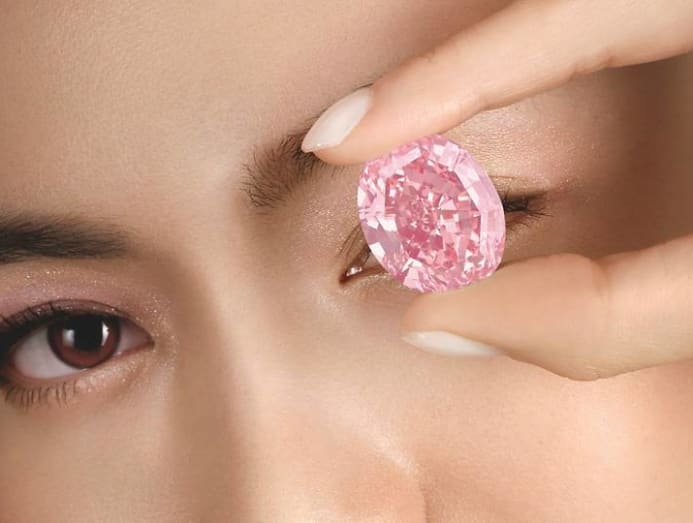
"This, combined with the fact that at that place are more than and more connoisseurs around the world competing for these diamonds, specially in Asia, drives the prices up," she said.
In April 2022 the CTF Pinkish Star, a 59.half-dozen-carat fancy brilliant pinkish diamond, became the earth'due south most expensive jewel sold at auction when Hong Kong jewellery company Chow Tai Fook bought it for U.s.$71.2m. Last November the 19-carat Pink Legacy diamond ready a new record cost per carat for pink diamonds at sale in Geneva when it sold for £38.5m, or nigh £2m per carat, to United states of america jeweller Harry Winston.
Simply diamond prices can swing wildly depending on factors including color, consumer tastes and what others are willing to pay. This makes them difficult assets to invest in.
"The rarest diamonds (such as these fancy colours, the largest diamonds, or those with peculiarly interesting histories), nowadays less of a challenge for potential investors who aren't diamond experts," said one executive at a major jewellery house who wanted to remain anonymous. "The challenge with diamond investment outside of this is that diamonds are a not-homogenous product."
"Exceptional coloured diamonds accept seen an especially pronounced growth trend in the last five to eight years. This, combined with the fact that at that place are more than and more connoisseurs effectually the world competing for these diamonds, especially in Asia, drives the prices up." – Laurence Nicolas
Unlike golden, for example, diamonds do non have a standard toll per carat. The value of each rock is based on a combination of the four Cs: Carat, colour, clarity and cutting. The cost of any stone depends on an assessment of its inherent qualities as well as the price and quality of other diamonds in the market. A murky four-carat diamond could attract a lower valuation than a lighter simply internally flawless diamond, for instance. "It isn't a straightforward assessment of the value of the investment product," sais the industry executive.
Emily Barber, manager of jewellery at auction business firm Bonhams, says the coloured diamond market is "very complex". Prices differ depending on the intensity of the colour and the improver of a secondary colour within the stone may too affect the value. A one-carat fancy brilliant blue stone is worth well-nigh 10 times more than a ane-carat fancy light blueish stone, according to the Fancy Colour Enquiry Foundation, a non-profit organisation that promotes transparency in diamond sales.
"The clarity and carat size of the coloured diamond is as well a big factor," added Barber. "Larger stones command a bigger premium. This is why it's important to have a certificate from an internationally recognised laboratory stating both the colour and the clarity."
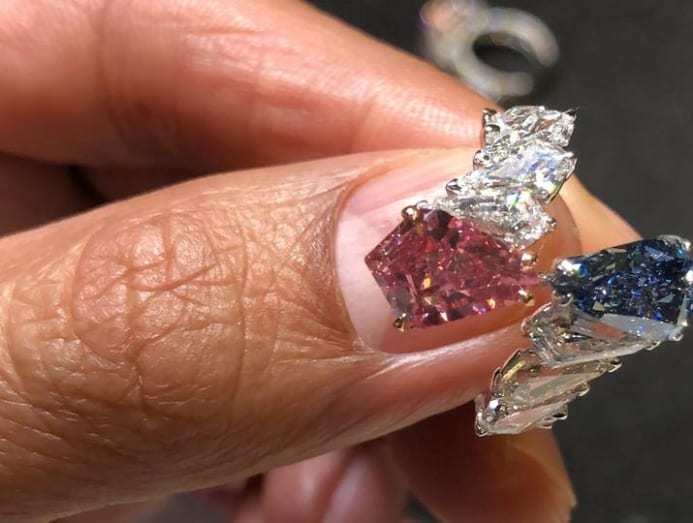
John Benjamin, an independent jewellery valuer, said even "certificated and fancy colour diamonds are subject area to a pricing structure which tin can be described as truly labyrinthine".
Investors can try to simplify the procedure if they want to put their money in diamonds. Some companies offer and so-called baskets of diamonds as an investment product. The Singapore Diamond Investment Exchange, the world'southward commencement commodity exchange where diamonds are handed over rather than money, offers investable baskets of GIA laboratory-graded diamonds of identical weight, cut, clarity and color. These can be invested in similarly to a commodities commutation traded fund.
Outside of diamonds, gemstones are experiencing a blast in popularity. The finest examples of rubies, emeralds and sapphires have enjoyed strong price rises over the past decade, according to Bonhams. It reported a 970 per cent price increase for Kashmir sapphires in the x years to July 2022 and a ane,100 per cent rise for certain examples of Burmese rubies. Over the same timeframe, the auctioneers accept seen a one,900 per cent toll increase for the virtually valuable Colombian emeralds.
READ> All that glittters: Seven of the about valuable jewellery to ever go nether the hammer
Such stones have besides experienced record-breaking sale sales recently. In June 2017, the 18.04-carat Rockefeller emerald prepare a new world tape per carat, selling for US$5.5m with Christie's in New York.
"In the past, things like rubies and sapphires were non appreciated in the aforementioned way that they are today," said Benjamin. "Very fine coloured stones such as greens, dejection and reds are at the very acme of the market now and sapphires particularly are making tape-breaking prices.
"Fine quality rubies, for case, tin be more valuable than diamonds of the same size. And in many cases the finest quality gemstones come up from mines that are no longer in operation, making them rarer and more sought-later."
"Very fine coloured stones such as greens, blues and reds are at the very top of the market at present and sapphires particularly are making tape-breaking prices." – John Benjamin
Valuations are based not only on a gemstone'southward objective characteristics but on what buyers are willing to pay. This ways modern jewellery can be particularly catchy to make coin on. "It can be very hard to become your investment dorsum," said Benjamin. "Modern jewellery tin can be easily worn and enjoyed but if you sell it on, it is rare you will get the money you paid back."
He adds that modern pieces will often just sell for the break-up value of the stones and the value of the precious metal in the setting. "The labour and manufacturing costs are rarely taken into account by buyers when selling new jewellery by all but a very few totemic designers."
All the same jewellery from certain modern eras can attract higher prices. Art Deco jewellery, from the 1920s and 1930s, and pieces from later decades are currently enjoying a resurgence, according to Bonhams.
READ> The Singapore jewellery collector with Elizabeth Taylor's lion head bracelet
"In that location is a renewed involvement in [jewellery from] the 1960s and 1970s," said Hairdresser, "which tends to be made of potent bold designs in yellow gold and semi-precious gemstones." She said jewellery past Andrew Grima, widely recognised equally one of the founding creators of modernistic jewellery in United kingdom, is currently enjoying a renaissance, with values rising appropriately.
His work "chimes with the modernist spirit in the fine art and compages of the 1960s", she added. "This was groundbreaking and avant-garde." Bonhams auctioned the largest private drove of Grima jewellery in September 2017, with pieces selling for three times pre-auction estimates, according to Barber.
Postwar jewellery, from 1945-75, experienced an 89 per cent rising in values between 2007 and 2016, according to Art Market Research. Meanwhile, prices for Fine art Deco and Belle Epoque (1890 to 1915) jewellery rose past equally much as 72 per cent between 2007 and 2018.
"There is a renewed interest in [jewellery from] the 1960s and 1970s, which tends to be made of strong bold designs in yellow gold and semi-precious gemstones." – Emily Barber
Mail-modern work tends to be "abstract and asymmetrical" and can be "very hit and bold", according to Benjamin. "It is investment jewellery but the problem is that it has become number one on the must-have list," he added. "Everybody wants it and prices have shot through the roof. There is an argument to say the market is as well strong for this currently."
Benjamin believes would-be investors could be better placed buying jewels from less stylish times, citing Victorian and Georgian-era pieces. "Victorian jewellery is a little like brownish furniture. It just isn't fashionable at the moment – no 1 wants a mahogany chest of drawers. But there will be a tipping betoken in time to come when information technology starts to be recognised for the quality it is," he said.
Certain jewels and brands have held their value over time. Names such as Cartier and Van Cleef & Arpels from the 1920s and 1930s are highly prized and take been less subject to the whims of manner, particularly pieces that are signed, according to those in the industry.
READ> Van Cleef & Arpels welcomes jump with new additions to Frivole Collection
"If you are lucky enough to ain a 1910 Cartier brooch, signed, and then that has never gone out of fashion," said Mr Benjamin. "If you had the classic Art Deco diamond clip gear up with lovely twinkly diamonds, yous will have dealers queueing up to buy."
In May, a Van Cleef & Arpels iconic Goose egg necklace from the 1950s was sold for CHF 507,000 (S$701,475), according to Sotheby'southward, 10 times the low end of its judge.
At that place are several means for investors to buy or sell jewellery, purchasing it new or taking a run a risk at auction. Only ownership in the retail market means accepting very high mark-ups, particularly for rare pieces, and investors are unlikely to see any value uplift for many years. Auction houses offer a broader range of jewels from a vast range of periods but there, besides, pricing is non straightforward.
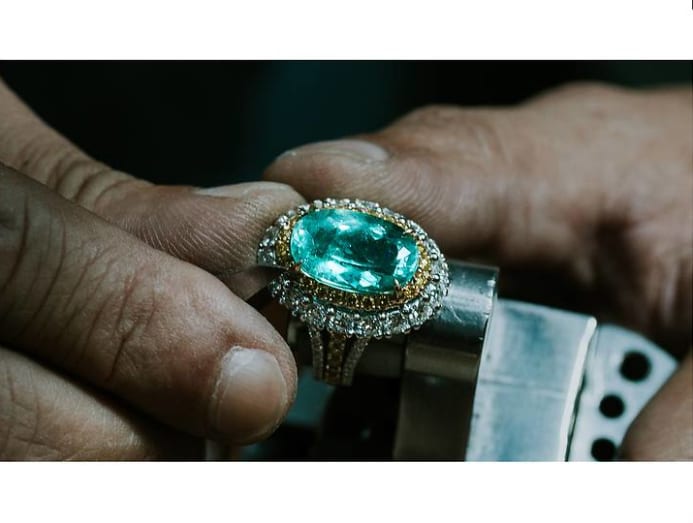
Listing prices are based on what similar jewels are fetching and deed equally a guide to bidders. But these prices can be far lower than those in shop windows. Auction houses besides charge a commission to sellers, which volition come out of the terminal sale price.
Insurance valuations are too not a definite guide to what a piece could sell for. Jewels are insured based on their replacement value, rather than the corporeality they could fetch at sale. This means the price you are given past an independent valuer employed by an auction house is no guide to whether information technology could reach that toll when you sell, co-ordinate to Sotheby's.
In the stop, experts say people should honey the jewellery they buy. "You don't just buy jewellery to invest in, you lot purchase it because you lot dearest and desire to wear it," said Benjamin. "That is particularly important if you lot might have to wait several years before you lot tin can get your money back."
Past Kate Beioley © 2022 The Financial Times
READ> Interested in building a gem collection? These eight stones are likely to abound in value
Source: https://cnalifestyle.channelnewsasia.com/obsessions/jewellery-investment-240096
0 Response to "Jewellery investment: Advice on how to navigate the current volatile market"
Post a Comment